
Are gutter guards worth it in South Carolina?
Quick answer
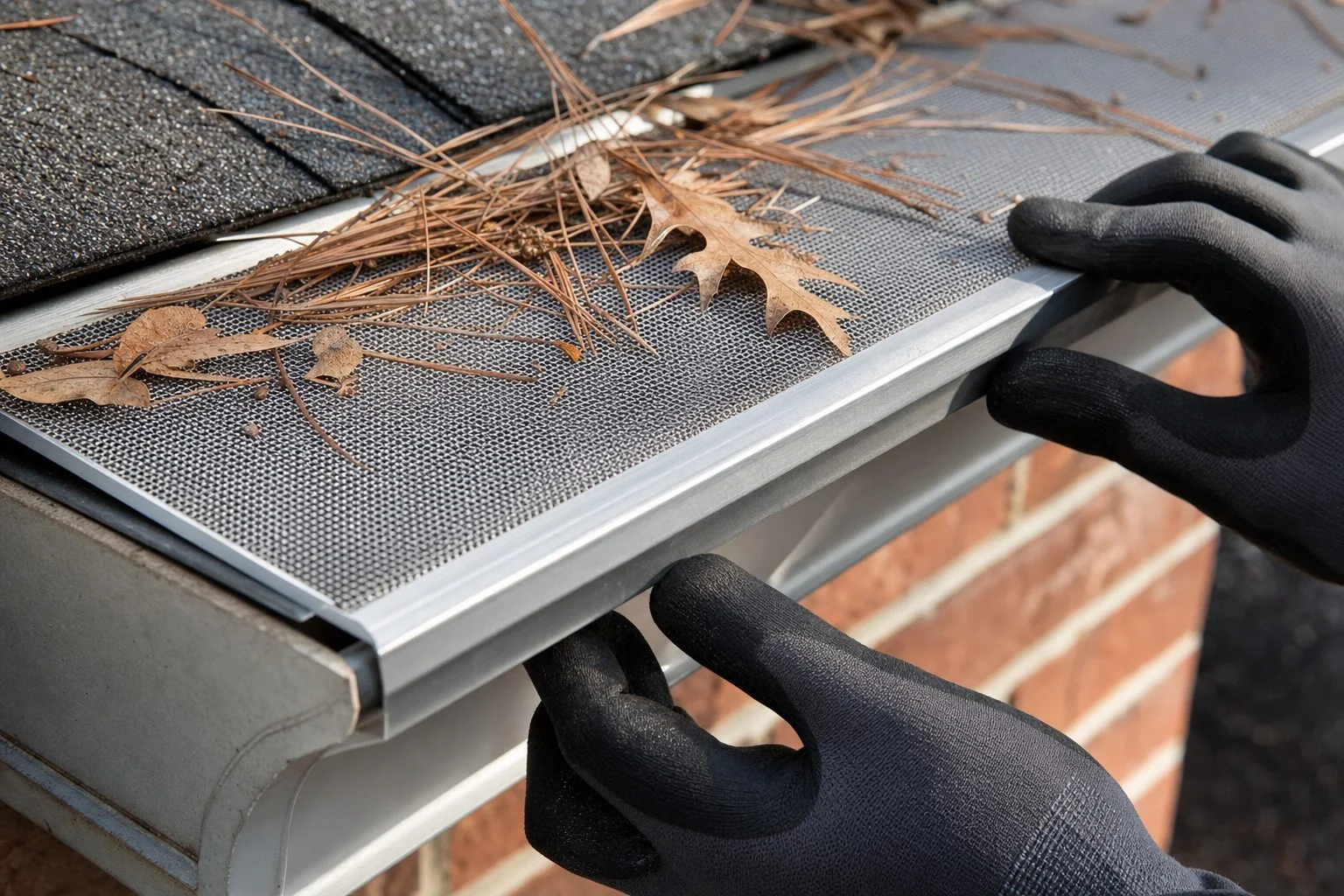
Under Midlands pines, stainless micro-mesh gutter guards are worth the money — they eliminate two to four cleanings a year and prevent the overflow that rots fascia, typically paying back in three to five years. Screens, foam and brush guards are not worth it here; pine needles defeat all three.
The Midlands debris problem is not leaves. It is loblolly pine needles: thin, stiff, shed year-round, and perfectly shaped to slip through any opening bigger than about a millimeter and then weave into a mat that water cannot pass. Any guard evaluated on how it handles oak leaves is being tested on the wrong problem.
Which gutter guard types actually work here?
| Type | Cost / linear ft | Stops pine needles? | Midlands verdict |
|---|---|---|---|
| Stainless micro-mesh | $8 – $14 | Yes | The only type we install |
| Perforated aluminum | $5 – $9 | Partially | Handles leaves; needles slip through |
| Reverse-curve / surface tension | $16 – $30 | Mostly | Works, but overshoots in hard downpours |
| Foam inserts | $3 – $6 | No | Needles embed; foam holds water and degrades |
| Brush / bottle-brush | $3 – $6 | No | Becomes a debris nest |
| Plastic snap-in screen | $2 – $5 | No | UV-brittle in SC sun, pops off in wind |
We remove more foam and brush inserts than we install of anything else. They are cheap, easy to sell, and in a pine environment they actively make things worse by holding organic debris and moisture inside the trough.
What is the real payback on gutter guards?
Quick answer
A typical Midlands home with 160 linear feet of gutter pays $1,300–$2,200 for micro-mesh guards. Against three professional cleanings a year at $150–$250 each, that is roughly a three to five year payback — before counting avoided fascia rot, which runs $14–$26 per linear foot to repair.
| Scenario | Up-front | Annual | 10-year total |
|---|---|---|---|
| No guards, 3 cleanings/year at $200 | $0 | $600 | $6,000 |
| Micro-mesh guards, occasional brush-off | $1,750 | ~$100 | $2,750 |
| No guards, DIY cleaning | $0 | Your Saturdays | Plus fascia repair risk |
The part guard companies leave out
Quick answer
No gutter guard is maintenance-free. Pine needles still collect on top of micro-mesh and need to be brushed or blown off once or twice a year. The difference is that it becomes a five-minute surface task instead of scooping decomposed sludge out of the trough.
If a salesperson tells you their product means you will never touch your gutters again, they are overselling. Micro-mesh keeps debris out of the trough — that is the whole value proposition, and it is a big one. But a needle mat sitting on top of mesh can still slow water flow during a downpour. A leaf blower from the roof edge, once or twice a year, handles it.
Guards cannot fix an undersized gutter
Quick answer
Adding guards to undersized 5-inch gutters with too few downspouts does not solve overflow. In the Midlands, 6-inch gutters with 3x4 downspouts carry roughly 40–70% more water and are the actual fix for homes with large roof planes or heavy pine cover.
We see this constantly: a homeowner adds guards, still gets overflow in a thunderstorm, and concludes guards do not work. The real problem was capacity. Columbia summer storms drop an inch in twenty minutes; a 1,200 square foot roof plane sends roughly 750 gallons at the gutter in that window. Five-inch gutters with two downspouts cannot move it, guards or no guards.
Our approach is to size the system first — gutter width, downspout count and placement, and pitch — then add guards. See seamless gutters for pricing, or the full gutter guard comparison.