
Do hurricanes really damage roofs in the Columbia SC area?
Quick answer
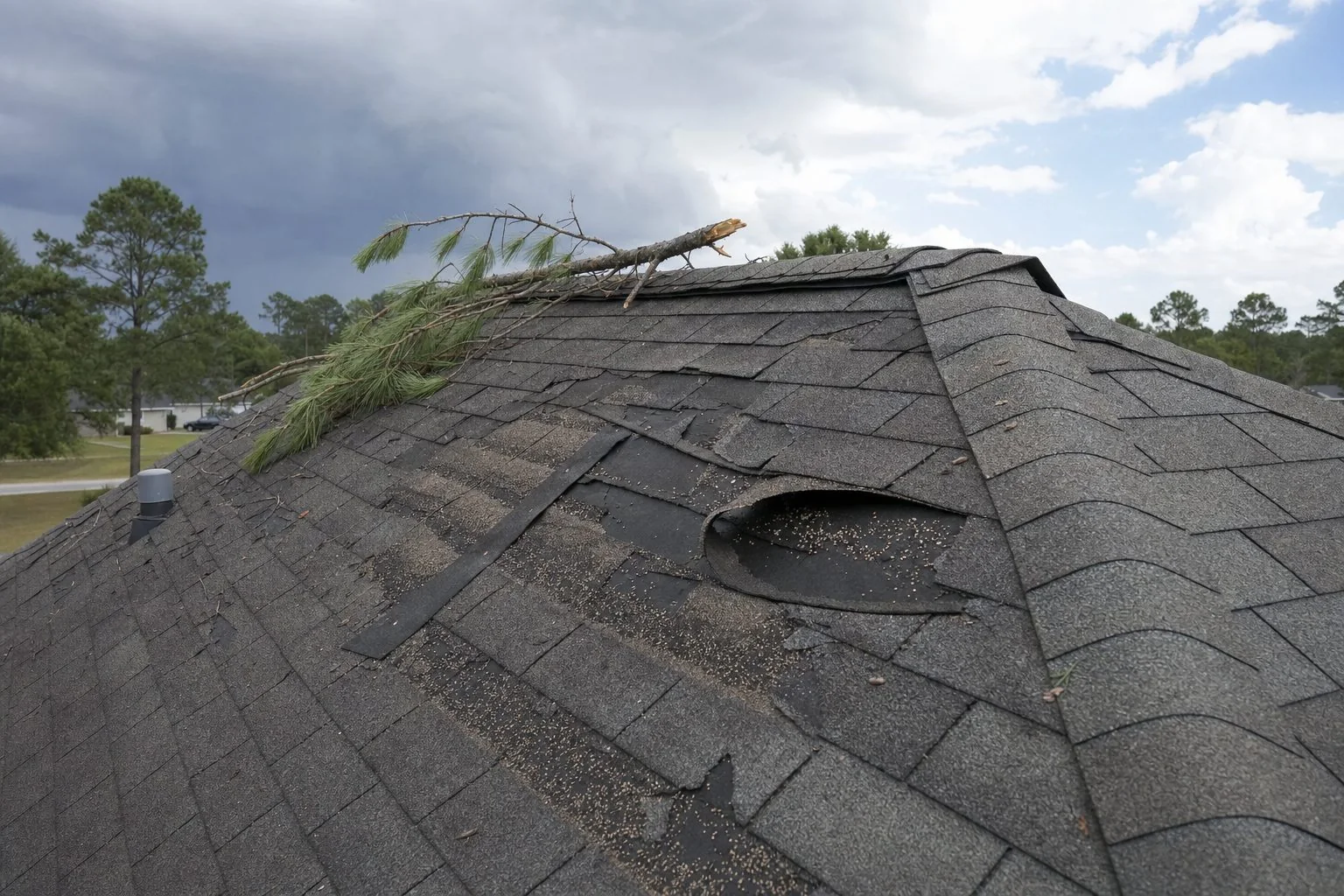
Yes. Tropical systems weaken over land but still deliver damaging wind and rain to the SC Midlands — the remnants of Hurricanes Matthew (2016), Irma (2017) and Michael (2018) all produced wind and tree damage across Columbia, the Midlands and any home within 90 minutes of West Columbia, and inland flooding remains a serious risk.
Inland damage looks different from coastal damage. You are less likely to lose an entire roof to 130 mph sustained wind and far more likely to experience 50–70 mph gusts that break shingle sealant bonds, saturated soil that lets 80-foot loblollies fall on houses, and multi-inch rainfall that overwhelms undersized gutters and finds every weak flashing detail. That is the failure mode we prepare Midlands roofs for.
What should I do to my roof before hurricane season?
Quick answer
Before hurricane season, have your roof professionally inspected, replace cracked pipe boots and loose ridge caps, secure or replace lifted shingles, clear gutters and valleys, verify downspout drainage away from the foundation, and remove overhanging or dead limbs within reach of the roof.
| Task | Why | Cost |
|---|---|---|
| Professional roof inspection | Finds loose shingles and failed details that wind exploits | Free with Beaver Roofing |
| Replace cracked pipe boots | Wind-driven rain enters at penetrations first | $375 – $550 each |
| Re-secure or replace ridge and hip caps | Caps are the first thing wind lifts | $300 – $900 |
| Clear gutters, valleys and downspouts | Prevents overflow and backflow under shingles | $150 – $300 |
| Verify downspout discharge 10+ ft from foundation | Protects crawlspaces in Midlands red clay | $18 – $32 / ft to extend |
| Trim overhanging and dead limbs | Limb strikes are our most common tropical-remnant claim | Arborist quote |
| Photograph the roof and exterior | Establishes pre-storm condition for a future claim | Free |
Photograph your roof before the storm, not after
Quick answer
Take dated photos of every roof slope, gutter run and exterior elevation before storm season. Pre-loss documentation is the single most effective defense against an insurance carrier claiming your storm damage was pre-existing wear and tear — the most common reason SC claims get denied or underpaid.
As an estimator, this is the tip I wish every homeowner took. Stand at each corner of the house, photograph each elevation and each roof slope from the ground with a phone, and store the photos somewhere with a date stamp. It takes ten minutes once a year. When an adjuster later says "that granule loss looks like age," a dated photo from three months earlier showing an intact slope ends the argument.
Keep your last roof invoice, permit and warranty registration in the same folder. Roof age and documented maintenance both matter to claim outcomes.
Review your policy before the season, not after the loss
Quick answer
Check three things on your declarations page: whether you have replacement cost value (RCV) or actual cash value (ACV) roof coverage, your wind and hail deductible amount or percentage, and whether any roof-age or cosmetic-damage exclusions apply. These determine what you actually collect.
- RCV vs. ACV. ACV roof endorsements are increasingly common and pay only depreciated value — on a 15-year-old roof that can be less than half the replacement cost.
- Percentage deductibles. A 2% wind/hail deductible on a $400,000 dwelling limit is $8,000, not $1,000.
- Cosmetic damage exclusions. Increasingly attached to metal roofs; they exclude denting that does not affect function.
- Roof age limits. Some carriers restrict coverage or refuse renewal on roofs past 15 or 20 years.
We walk homeowners through their declarations page for free. Not because we sell insurance — we do not — but because knowing these numbers in advance prevents a nasty surprise at the worst possible moment.
What to do when the storm actually hits
Quick answer
During and after a Midlands storm: stay off the roof, check ceilings and the attic for water intrusion, move belongings away from active leaks, photograph everything, and call for emergency tarping if water is entering. Beaver Roofing tarps 24/7 at (803) 991-7663.
Tarping is genuinely urgent. Water that enters a roof does not stay at the roof — it saturates insulation, runs down wall cavities, and starts mold growth within 24 to 48 hours in Midlands humidity. Getting a proper tarp installed, rather than a bedsheet of plastic weighted with bricks, limits the loss and demonstrates to your carrier that you mitigated damage as your policy requires you to.
Then be careful who you sign with. After every storm, out-of-state crews flood the Midlands with clipboards and "free roof" pitches. Ask where their shop is. Ours is at 3190 Leaphart Rd in West Columbia, and we have been here since 2011. Read our vetting checklist.