
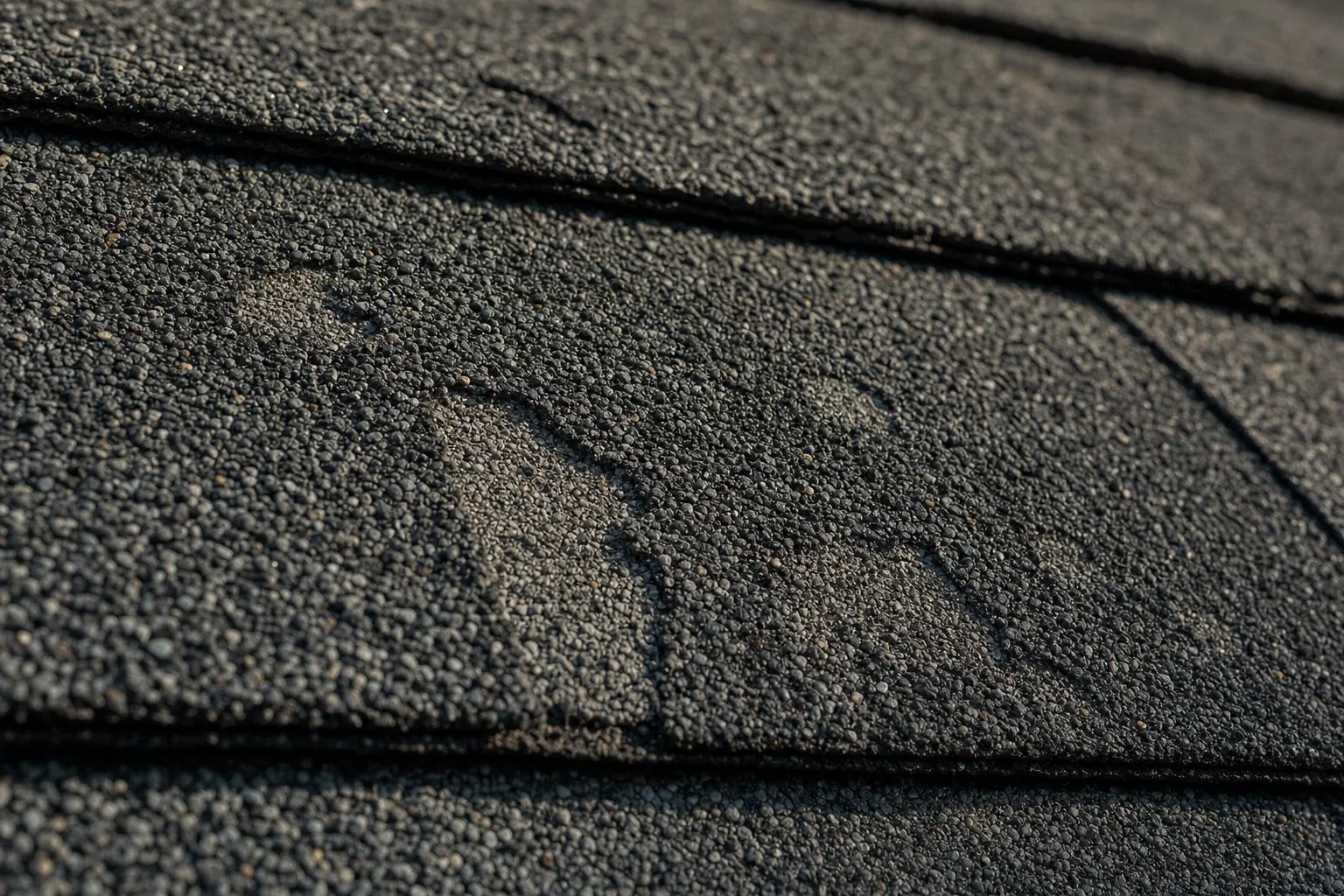
What can a homeowner check without getting on the roof?
Quick answer
From the ground you can check for missing or lifted shingles, dark patches of granule loss, sagging roof planes, damaged ridge caps, rusted flashing, granules collecting in gutters and at downspout outlets, and daylight or water stains visible in the attic. Never walk on the roof yourself.
Eight things to look at this weekend, with binoculars and a flashlight:
- Roof plane straightness. Sight along the ridge and eave. Waves or dips mean decking or framing problems.
- Missing, curled or lifted shingles. Especially on the west and south slopes, which take the worst SC sun.
- Dark patches. Areas noticeably darker than surrounding shingles usually mean granules are gone and asphalt is exposed.
- Ridge and hip caps. These fail first in wind. Cracked or missing caps are an open water path.
- Flashing and boots. Look at chimneys, vents and pipe penetrations for rust, gaps or a cracked rubber collar.
- Gutters. A pile of granules that looks like coarse sand means the roof is shedding its protective layer.
- Fascia and soffit. Soft, stained or peeling wood behind the gutter means water has been getting behind it.
- Attic. Flashlight on the underside of the deck — dark staining, rusted nail points, damp insulation, or daylight anywhere it should not be.
What does Beaver Roofing's 19-point inspection cover?
Quick answer
Beaver Roofing's free 19-point inspection documents shingle condition per slope, ridge and hip caps, all flashings, pipe boots, valleys, decking, attic ventilation, gutters and fascia, penetrations, and evidence of storm damage — with photographs of every slope and a written report you keep.
| # | Checkpoint | Why it matters |
|---|---|---|
| 1–3 | Shingle condition, granule loss and pliability per slope | Establishes remaining service life and storm vs. age damage |
| 4 | Ridge and hip cap integrity | First failure point in wind |
| 5–6 | Valley construction and membrane presence | Highest-volume water path on the roof |
| 7–8 | Step, wall and kick-out flashing | Leading cause of hidden wall rot in the Midlands |
| 9 | Chimney counterflashing and cricket | Caulked counterflashing always fails |
| 10 | Pipe boots and collars | Rubber collars fail around year 10–12 |
| 11 | Vents, skylights and penetrations | Each one is a manufactured hole in your roof |
| 12–13 | Decking condition and fastening | Structural soundness and nail-holding capacity |
| 14–15 | Attic intake and exhaust ventilation, net free area | Directly determines shingle lifespan in SC heat |
| 16 | Attic moisture, staining and insulation condition | Reveals active or historic leaks |
| 17 | Gutters, downspouts, drainage and fascia | Roof water management and rot risk |
| 18 | Soft-metal collateral damage survey | Key evidence for hail and wind claims |
| 19 | Photo documentation of every slope and elevation | Your record — and the adjuster's |
What attic signs mean I have a roof leak?
Quick answer
In the attic, look for dark water staining on the underside of the decking, rust on nail points, compressed or damp insulation, mold on rafters, and daylight through the roof deck. Staining directly below a penetration usually indicates a failed boot or flashing rather than a whole-roof problem.
Attic diagnosis beats roof-surface guessing. Water travels — a stain on a bedroom ceiling can originate six feet uphill. Following the trail from the ceiling stain up the rafters to the highest point of wetness on the decking is how you find the actual entry point. Note also that not all attic moisture is a leak: in humid Midlands summers, poor ventilation causes condensation on the underside of the deck that looks exactly like one.
How often should a roof be inspected in South Carolina?
Quick answer
Have a South Carolina roof professionally inspected every two years, annually once it passes 15 years of age, and after any hail event or storm with winds above about 50 mph. Beaver Roofing's inspection is free, and there is no obligation attached to it.
Two more triggers: before buying a home (a general home inspector is not a roofer), and before your policy renews if your carrier has been asking about roof age. Documented maintenance and inspection records also strengthen a future storm claim, because they establish the roof's condition before the loss.
What should I do immediately after a storm?
Quick answer
After a Midlands storm: check the attic and ceilings for active water, photograph any debris or hail, note the date and time, and call a local roofer for a documented inspection. If water is entering, get an emergency tarp on it — Beaver Roofing tarps 24/7 at (803) 991-7663.
What not to do: do not sign anything a door-knocker hands you, especially an "authorization to inspect" that is actually a contingency contract assigning your claim. Do not let anyone on your roof who is not insured. And do not wait — South Carolina policies generally require prompt notice with roughly a one-year filing window for wind and hail. Read the full claim guide.